Buying guide
A whistle, an alarm, and what each one asks of you.
A whistle costs almost nothing, never runs flat and will outlive most of what is in your bag. That is a genuinely good argument, and it is why whistles are still sewn into rucksack straps and clipped to life jackets. The question worth asking is narrower: what does each object need from you at the moment you reach for it, and can you supply it?
A whistle runs on your breath
This is the difference everything else hangs from. A whistle needs air, a free mouth and enough composure to take a proper breath. In calm conditions that is nothing at all. When you are out of breath from running, when your jaw is tight, when someone is close enough to cover your face, it stops being nothing.
An alarm asks for something different: one hand, and a pull. It will sound at full volume whether you are winded, frightened or silent, and it keeps sounding while you use your voice for something else, like saying a name, an address or the word police. Those are two different kinds of demand, and neither is automatically the lighter one.
It is worth being honest about the reverse case too. If your hands are full, gloved and clumsy, or busy on a rope or a handlebar, a whistle already at your collar is the faster of the two, because your mouth is the only thing it needs.
Volume, pitch and how far the sound really travels
A good pealess whistle is genuinely piercing, and its pitch is well chosen: high, hard and unlike anything else outdoors, which is why it carries in open country. But its volume is only ever as steady as the person blowing it. Blow gently and you get a thin note. Blow while shaking and you get a note that wobbles and stops. Keep blowing and the breath behind it fades, well before you would like it to.
A siren has no such variation. It sounds at its own level for as long as it runs, which matters less for raw distance than for the shape of the sound. A continuous, unbroken noise is easier for a passer by to locate and harder to mistake for a bird, a referee or children playing.
In town, where noise competes with traffic and closed windows, constancy counts for more. In open country, where sound travels and there is nothing to compete with, a whistle can be heard a long way with little effort, and a repeated series of blasts is understood as a call for help.
- Whistle: excellent pitch, volume that depends entirely on your lungs
- Alarm: constant level, easier for a stranger to locate
- Whistle: understood outdoors as a distress signal in its own right
- Alarm: keeps sounding while you speak, move or dial
Where the whistle is simply better
Nothing to charge, nothing to update, nothing to fail silently in a drawer. A metal or hard plastic whistle survives being sat on, frozen, soaked and dropped down a slope, and it works the moment you pick it up again. Months of neglect change nothing about it, which is more than can be said for most electronics.
It is also cheap enough to buy several and leave one on every bag, and light enough that you forget it is there. On a hike, on a mountain, on the water, in a country where you would rather not depend on a battery or a phone signal, that combination is hard to beat. Buy the pealess kind: the small ball inside a traditional whistle jams when wet or frozen.
And it is quiet until you use it. A whistle cannot go off in your pocket, cannot need a firmware note, cannot be confiscated as anything other than what it is. If you want one object that will still work years from now with no maintenance at all, buy the whistle and stop reading here.
Where the alarm earns its place
Two practical things separate them in everyday urban use. The first is that a whistle stops the instant you stop blowing, so it cannot buy you time while you walk away, get through a door or put distance between yourself and whatever prompted it. An alarm goes on making a scene without you, which is often the point.
The second is discretion, in an odd sense. Raising a whistle to your lips is a visible, telegraphed movement that takes a second and announces itself. A pull on something already in your hand does not. For the same reason, an alarm is easier to use badly by accident, which is a real cost, not a footnote.
The honest limits run the other way too. An alarm has a battery, and a battery is a thing you have to remember. It is more expensive than a whistle, it can break, and if it is at the bottom of a bag it is worth nothing. Neither object stops anyone: both work by drawing attention, and attention is only useful where there are people.
- Whistle: stops the moment you stop blowing
- Alarm: keeps sounding on its own while you move away
- Whistle: nothing to charge, nothing to break
- Alarm: needs charging, and needs to be within reach
Choosing by where you actually spend your days
If your walks are rural, if you are often out of phone coverage, if cold and water are part of the picture, the whistle is the sensible answer and adding a battery to your kit solves nothing. Many people carry both for exactly this reason, one on the rucksack strap and one on the keys, and never feel the redundancy.
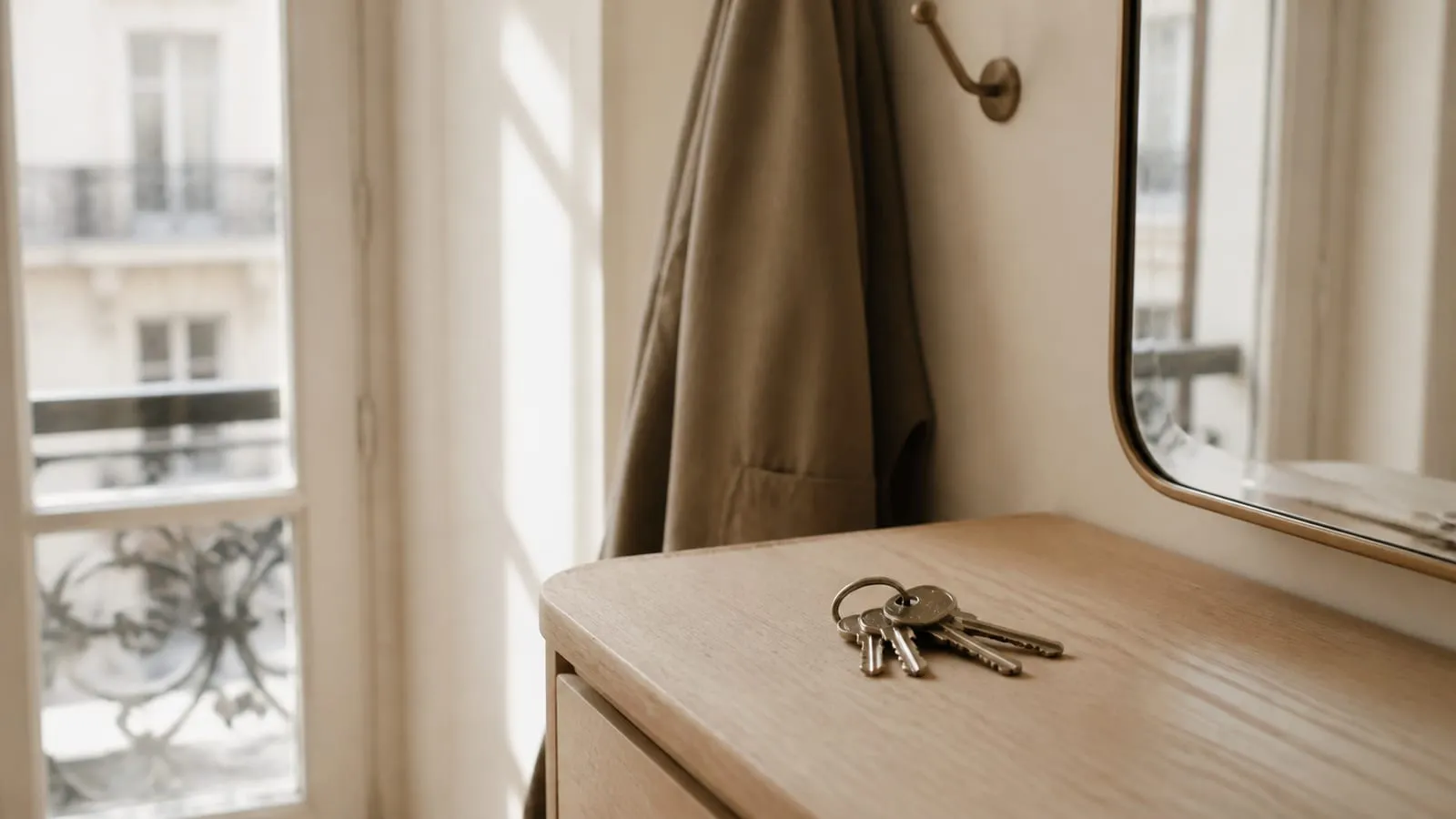
If your evenings are urban, if you are usually a few metres from other people, and if what you want is noise that continues while you leave, an alarm fits that shape better. OYA is one of those: it lives on a keyring and you pull the loop upwards to start a 130 dB siren. If a phone is paired over Bluetooth, the same pull triggers the phone native SOS and sends a position message to the emergency contacts you chose beforehand.
Be clear about what that does and does not include. There is no operator, no subscription, no monitoring centre, and no fall detection. Without a phone on you there is only the siren, which is precisely the thing a whistle also does, more cheaply and with no battery. Pick the one your ordinary week calls for, not the one that sounds most capable on paper.
Any questions?
Is a safety whistle loud enough on its own?
Outdoors, yes, a good pealess whistle carries a long way and its pitch cuts through wind and distance. In a noisy street the limit is not the whistle but you: the volume rises and falls with your breath, and it stops the second you need to speak or run.
Can a personal alarm replace a whistle for hiking?
Not really, and it is worth saying so. An alarm depends on a charge, and a battery is exactly what you would rather not rely on in cold, wet conditions far from a socket. A whistle is understood as a distress signal in the mountains and needs no maintenance at all. If you only take one, take the whistle.
What does an alarm do that a whistle cannot?
It keeps making noise after you let go, so it can cover the time you spend walking away or getting through a door. Some models also do something after the noise: with OYA, a paired phone triggers its own SOS and sends your position to contacts you chose. Without a phone on you, only the siren remains.
Should I carry both?
Plenty of people do, and it is not excessive. A whistle costs very little, weighs nothing and lives permanently on a rucksack strap for the outdoor case. An alarm on the keys covers the urban one. They answer different situations rather than competing.