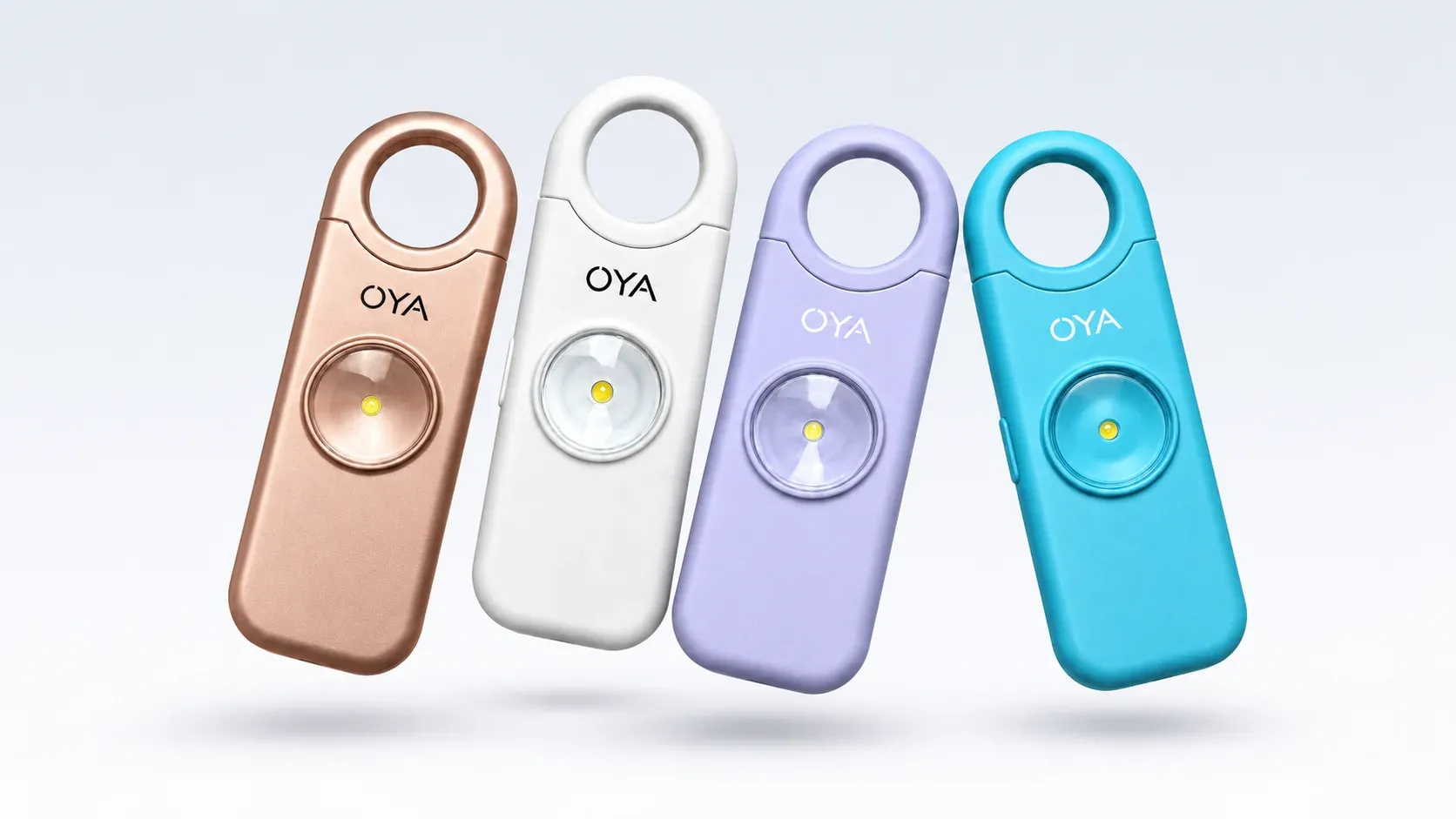
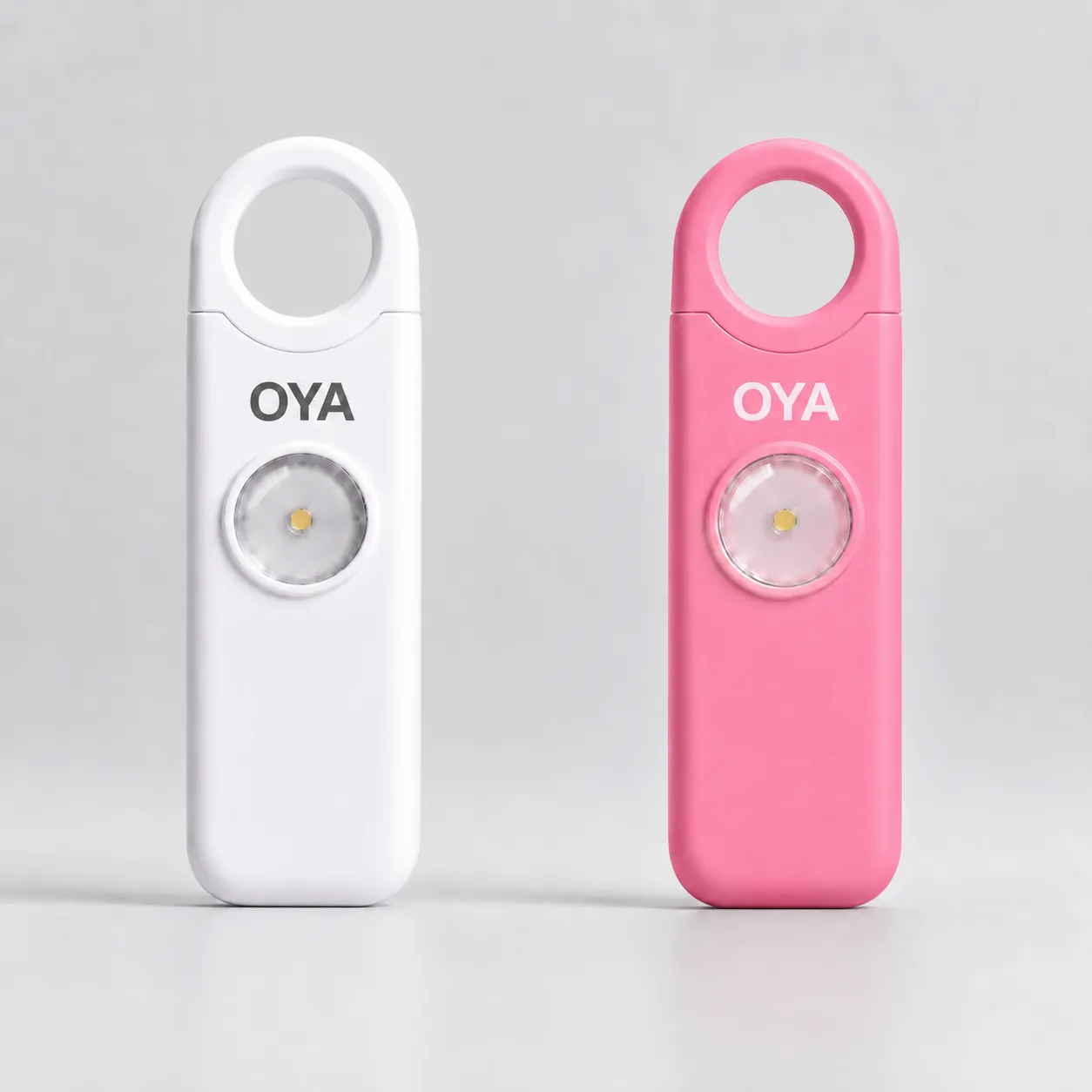
Buying guide
How to choose a personal alarm you will actually carry.
Six things worth checking before you buy, and the two numbers on the box that tell you the least.
This page is showing in English.
Voir en françaisAn alarm makes noise. OYA also lets people know.
| What each one does, and does not. | 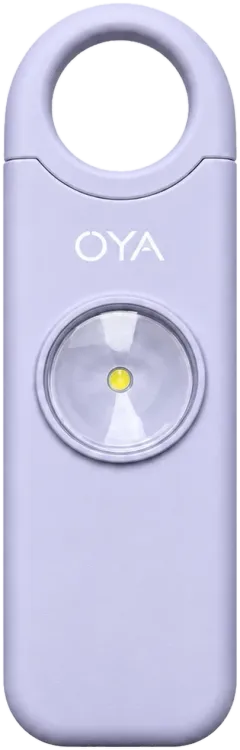 OYA | 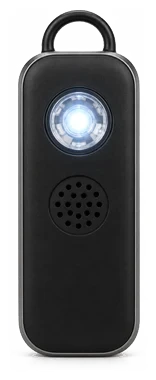 Pull-pin alarm | 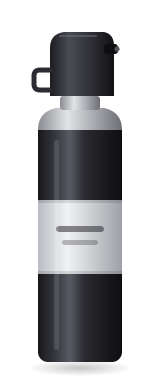 Pepper spray |  Safety app |
|---|---|---|---|---|
| Calls emergency services | through your phone | no | non | if the phone is in hand |
| Location sent to your people | through your phone | no | non | if the phone is in hand |
| Nothing to unlock | yes | yes | oui | no |
| 130 dB at 30 cm, with no phone | yes, the device alone | yes | non | no |
| Built-in light | yes | often | non | the phone torch |
The siren and the light run on their own, with no phone. The emergency call and the location message leave from your phone, through its own emergency settings: they depend on its battery and its network.
A personal alarm is a small device you carry on you that sounds a very loud siren the moment you set it off, to draw attention. Some models, paired with a phone, also get the emergency services or your people alerted.
Your phone is excellent right up to the moment you cannot get to it. OYA runs with no unlocking, no app to open and no need to hold anything: it triggers the phone SOS that handles the call and the location.
A plain alarm only makes a noise. OYA sounds the same 130 dB, then uses your phone’s SOS to call for help and send your position to the people you picked. The alarm is the opening move, not the whole game.
None. The device runs on its own with no monthly fee and no account to create.
Keep it if it suits you. OYA covers the moments an app cannot reach, when the phone is buried in a bag or there is no time to tap. Plenty of people use the two together.
The decibel scale is logarithmic: ten more decibels sound roughly twice as loud. But a figure only means something with its measuring distance, because sound fades as you move away: two alarms only compare at the same distance. OYA states 130 dB measured at 30 cm.
A pull pin is a separate part you tear out: proven, but you have to find it and put it back to stop the noise. A button is discreet, and harder to find in the dark. The loop on OYA stays attached to the device: pull it up with one hand to set it off, push it back down to stop it, with nothing to put back and nothing to lose.
They ask different things of you. Pepper spray has to be reached, aimed and kept out of the other person’s hands, and carrying it is restricted or banned depending on the country. A personal alarm is not a weapon: no carrying rule, no minimum age, and one movement.
A light is useful every day and needs neither a phone nor a network: the one on OYA is a white LED, steady or flashing, that the side button switches on without the siren. Built-in GPS needs a dedicated chip and, most of the time, a SIM card with a subscription. OYA has none: the position sent to your people is the one from your paired phone, through its native SOS.
It makes noise, and that is already useful. Three things are worth checking before you buy: the distance at which the stated volume is measured, whether it recharges or runs on batteries you keep having to buy, and what it does after the noise. OYA states 130 dB measured at 30 cm, recharges over USB-C and, paired with your phone, gets it to call for help.
Look first at who is selling: a named seller, with an address, a warranty and a right of return in writing. OYA is ordered on this site, from ALTHIR GROUP, a French company: dispatch from France, free delivery in France from 2 OYA, 30 days to change your mind and a 3-year warranty.
Yes. A personal alarm makes a sound and is not a weapon in any European Union country: no permit, no registration and no minimum age to buy or carry one. The objects that come with carrying rules are elsewhere, starting with pepper spray.
A personal alarm is not a weapon: nothing stops a minor from buying or carrying one. A school can set its own rules on what pupils bring in, so read them first. Have them try it once at home before pairing the phone, so only the siren goes off, and say what it does not do as well.
Two families of device answer two needs. A monitored alarm covers the home and a fall, with someone who answers. A pocket alarm covers journeys: noise, no subscription and, paired to a phone, the call for help, which assumes the phone is being carried.
It is if you can set it off at pace, with one movement and nothing to unlock. It adds to the rest without replacing it: a route in loops, reflective kit, one ear on the street and your location shared for the length of the run.
Five things can be checked on any model’s page: the volume in decibels and the distance it is measured at, the movement that sets it off, rechargeable or batteries, what the device does after the noise (siren only, or alerting your people and the emergency services through your phone), and the weight, since it decides whether you carry it. Our buying guide goes through them.
Nobody can guarantee that, and no alarm should promise it. What it does is simpler: a very loud noise that draws the attention of people nearby and makes the scene visible. Paired with a phone, OYA also gets that phone to call the emergency services and send your position to your people. Call 112 as soon as you can.
The one that goes wherever you go without a decision each morning. A keyring alarm comes with keys you already take out, while a wristband only helps on the days you put it on, so compare how each attaches before you compare the volume.
One that works in any country and flies with you. OYA’s siren needs no network, your phone’s SOS dials the emergency number of the country you are in, and the alarm travels in the cabin, never in the hold, because of its lithium battery.
Check what you may legally carry first. An alarm keychain only makes a sound, so no permit or age rule applies in the European Union, while sprays and objects made to hurt can be restricted or prohibited depending on the country, and have to be reached, aimed and kept out of other hands.
On a hill, often a whistle rather than an alarm: it needs no battery, works out of phone coverage and is understood as a distress signal. If you only take one, take the whistle; many people carry both, the alarm on the keys and the whistle on a rucksack strap.
A keyring alarm makes noise straight away and comes with keys you already carry. Anything worn, on the neck or the wrist, is always on you provided you put it on every day, and a pendant linked to a base unit is a monitored home alarm, a different service.
One you can set off with the hand already holding your keys, with nothing to unlock: on a last train or a night bus, one pull and the siren goes off at once. Paired with your phone, OYA also gets it to call for help and send your position.
that is €34.95 per device · 22% off
From €44.90, shipped from France, and 30 days to change your mind.
Buying guide
Six things worth checking before you buy, and the two numbers on the box that tell you the least.
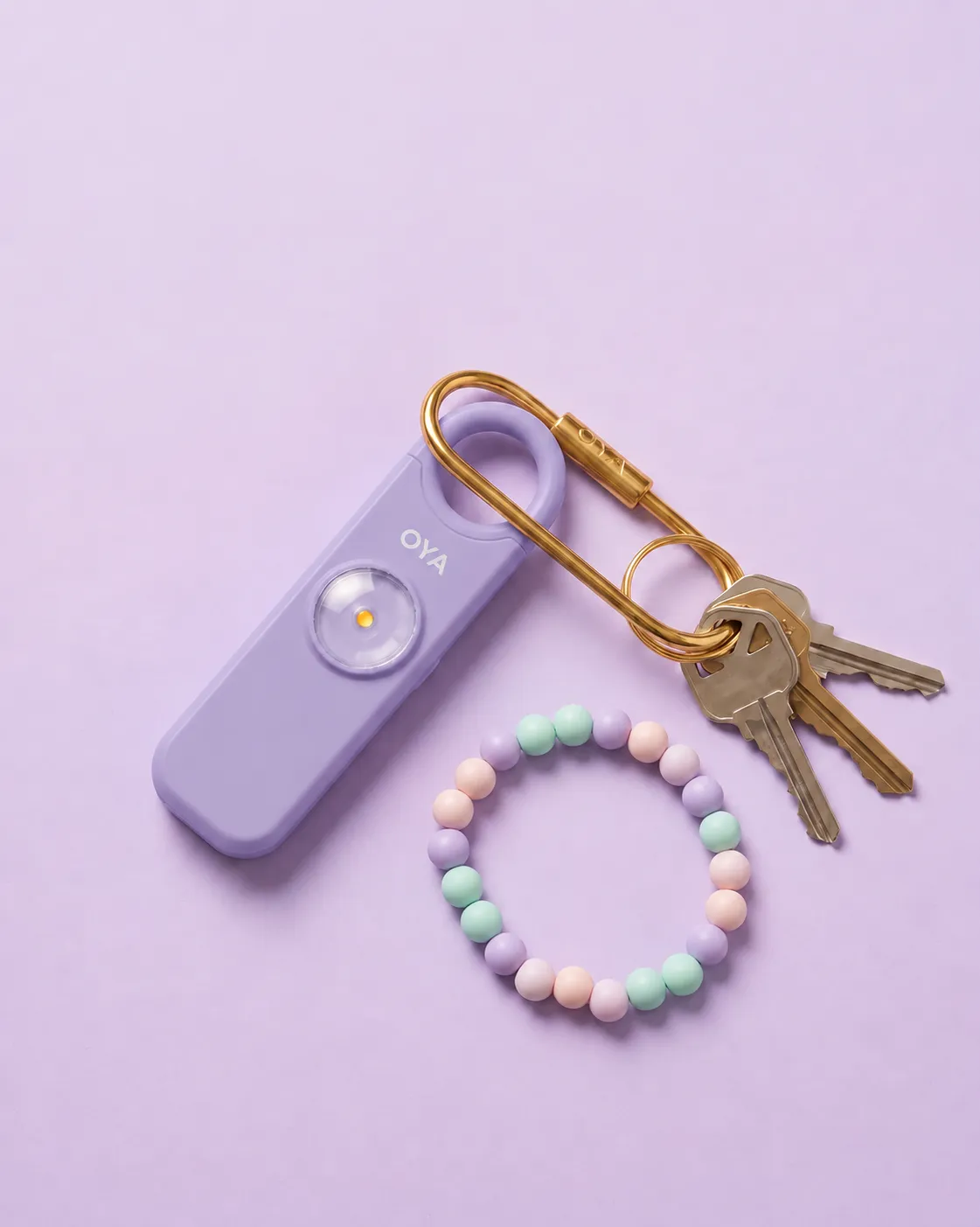
Buying guide
Two objects that make noise, and they are not interchangeable. One runs on your breath, the other on a battery, and that single difference decides most of the rest.
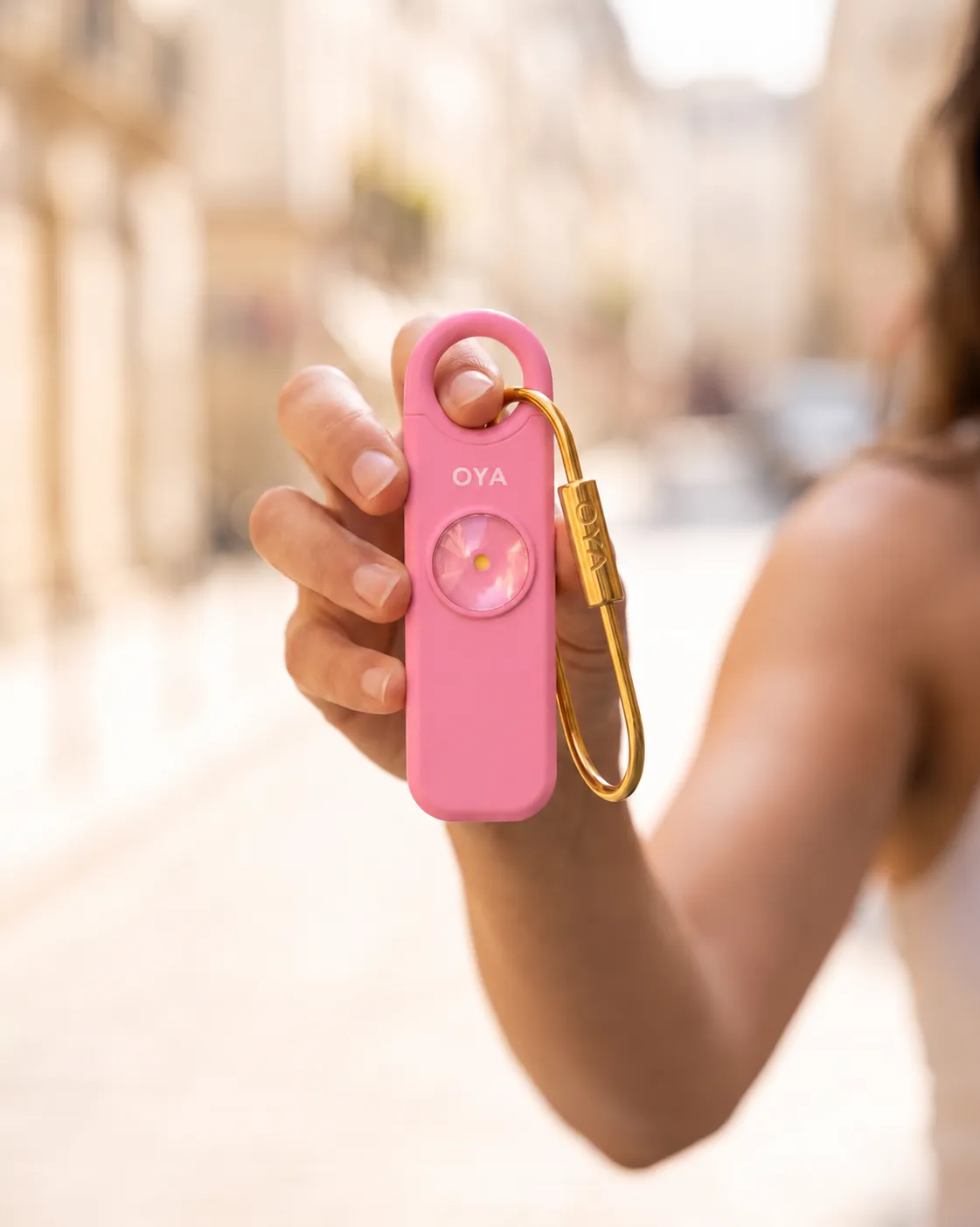
How it works
The decibel scale is not linear, which is why 130 dB is not slightly louder than 100 dB. It is roughly a thousand times the sound energy.

Buying guide
The question is not which one is better, but where your relative needs covering. Those two answers barely overlap.

Buying guide
Black Friday pushes you to buy fast. A useful gift starts with a slower question: what does her week look like, and what would make it easier?

Buying guide
The right gift starts with her week, not a shop aisle. Five lives, ideas for each, and one discreet item for the journey home.



Trop contente !
J’espère ne jamais avoir à l’utiliser mais c’est très rassurant de l’avoir sur moi en tant que femme dans la rue.
Utilisé avec des amis et approuvé ! super produit je recommande reçu en 2 jours avec suivi lettre verte ! Concept intéressant, j’apprécie que l’on reverse à une association !! Super produit !!! 🤩Bien reçu le produit et j'en suis très satisfaite ! MerciJe l'ai prise pour ma copine qui finit tard au boulot et rentre en métro. Elle la porte tous les jours sur son sac, et moi je suis beaucoup plus tranquille quand elle rentre seule Superbe alarme je recommande completement ! ⭐️⭐️⭐️⭐️⭐️Livraison rapide, très bon objet, je recommande.Très content du produit, je recommande Bien reçu ! Déjà sur le sac de ma petite sœur, c’est bruyant mais au moins je suis rassuré 👌.Produit arrivé rapidement, en très bon état. Le produit fonctionne très bienA selection of 5-star reviews published on Trustpilot. Read every review on Trustpilot