Everyday safety
Walking home at night: nine habits that hold up.
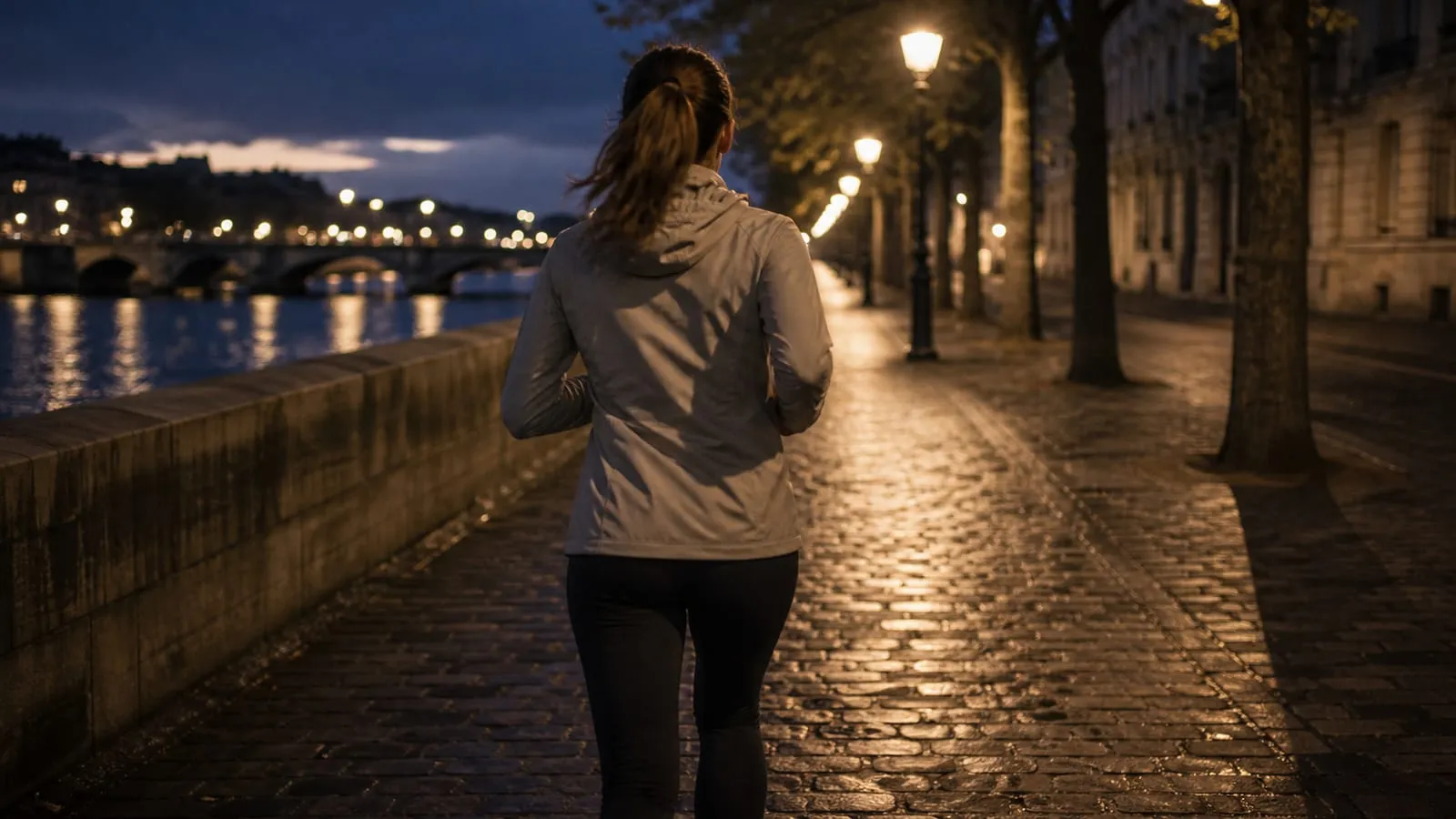
Advice about walking home at night usually assumes you are alert, unhurried and thinking clearly. The walk that worries you is the one where none of that is true. Here are nine habits built for the tired version of you.

Decide the route before you leave
A route chosen at the door is a route chosen once, calmly. A route chosen at a junction at one in the morning is chosen by whichever street looks least bad, which is not the same thing.
Pick the longer street with people and lights over the shortcut through the car park. Two extra minutes is a small price, and the decision costs nothing when you make it early.
Keep one sense free
Noise cancelling turns a street into a silent film. You lose footsteps, engines, a bike coming up behind you, someone calling out. That is most of your early warning.
You do not have to walk in silence. Transparency mode, one earbud, or the volume low enough to hear a car pulling in all keep the podcast and give you back the street.
Have your keys and your alarm out already
The doorstep is a slow moment: you stop, you look down, you dig through a bag. Fixing that is simply a matter of doing the digging earlier, while you are still walking.
The same goes for anything you carry for safety. A personal alarm at the bottom of a bag is a personal alarm you will never reach in time. On a keyring, in your hand, it is one pull away.
- Keys in your hand a street before you arrive
- Alarm on the same ring, so one hand finds both
- Phone in a pocket, not held out in front of you
Charge the phone, and set it up beforehand
The phone carries most of what comes above: it lights the way, it warns someone, it calls. It only does so if it is charged, and above all if it was set up beforehand. Emergency calling and the contacts to alert are configured once and for all in the native settings of both iPhone and Android, and the journal has an article on exactly that. Ten minutes on a Sunday, and you never do it again.
A phone at 4 % whose emergency contacts were never filled in will not help on the evening it was meant to. The rest is short: enough to pay for a ride you had not planned to take, and your ID.
- Emergency contacts filled in beforehand, not that evening
- The local emergency number: 112 across the European Union
- Enough to pay for a last-minute ride
Tell one person, not the whole group chat
Someone should know roughly where you are and roughly when you should be home. One person who will actually notice beats a group of ten who each assume somebody else is watching.
Live location sharing does this without a running commentary. You share for the length of the walk, they see the dot move, it stops when you get in. Nobody has to text “home safe” at 2am.
Trust the feeling before you can explain it
The urge to cross the road, walk into a shop or turn around usually arrives before the reason does. Waiting for the reason is what costs time. Cross first, work it out from the other pavement.
Being wrong about this has no cost at all. You crossed a street for nothing, which is a thing that happens several times a week to people who are never bothered by anyone.
Any questions?
Is walking with your phone in your hand safer?
Usually not. A phone held out is a screen you are watching instead of the street, and it is the single easiest thing to snatch. Keep it in a pocket and keep your eyes up.
Do personal alarms actually help?
A loud alarm buys attention and hesitation, which is often all you need. It works best when it also tells someone where you are, since noise alone does not bring anyone to you.
What should I do if I think I am being followed?
Cross the road, change direction and head somewhere with people and light: a shop, a petrol station, a busy street. Call someone and say out loud where you are.